
Replacement dwellings in Angus.
When replacement can be a realistic route.
Part of our wider work on Self-Build Homes in Angus.
Understanding replacement dwellings in practice.
Replacing an existing building with a new home can be an attractive route for self-builders in Angus, particularly in rural or edge-of-settlement locations where new houses can otherwise be difficult to justify. This also has the potential to mitigate VAT costs that accrue on construction works when refurbishing or extending an existing property.
In practice, however, replacement dwellings are not automatically acceptable. Whether a proposal is supported depends on the status of the existing building, how the replacement is conceived and how well resolved the design proposal is.
This page outlines how replacement dwellings are typically assessed in Angus, and where careful judgement is required.
What qualifies as a replacement dwelling?
A replacement dwelling usually involves demolishing an existing house and constructing a new one in its place. The key consideration is whether the existing building is recognised as a lawful dwelling in planning terms.
Questions that often need to be clarified include:
Is the existing building established as a dwelling, rather than an outbuilding or former use?
Is it still in residential use or has it been abandoned or converted?
Is there clear evidence of lawful residential status?
Where the status of the existing building is uncertain, replacement may not be supported in principle.
Scale, siting and form matter.
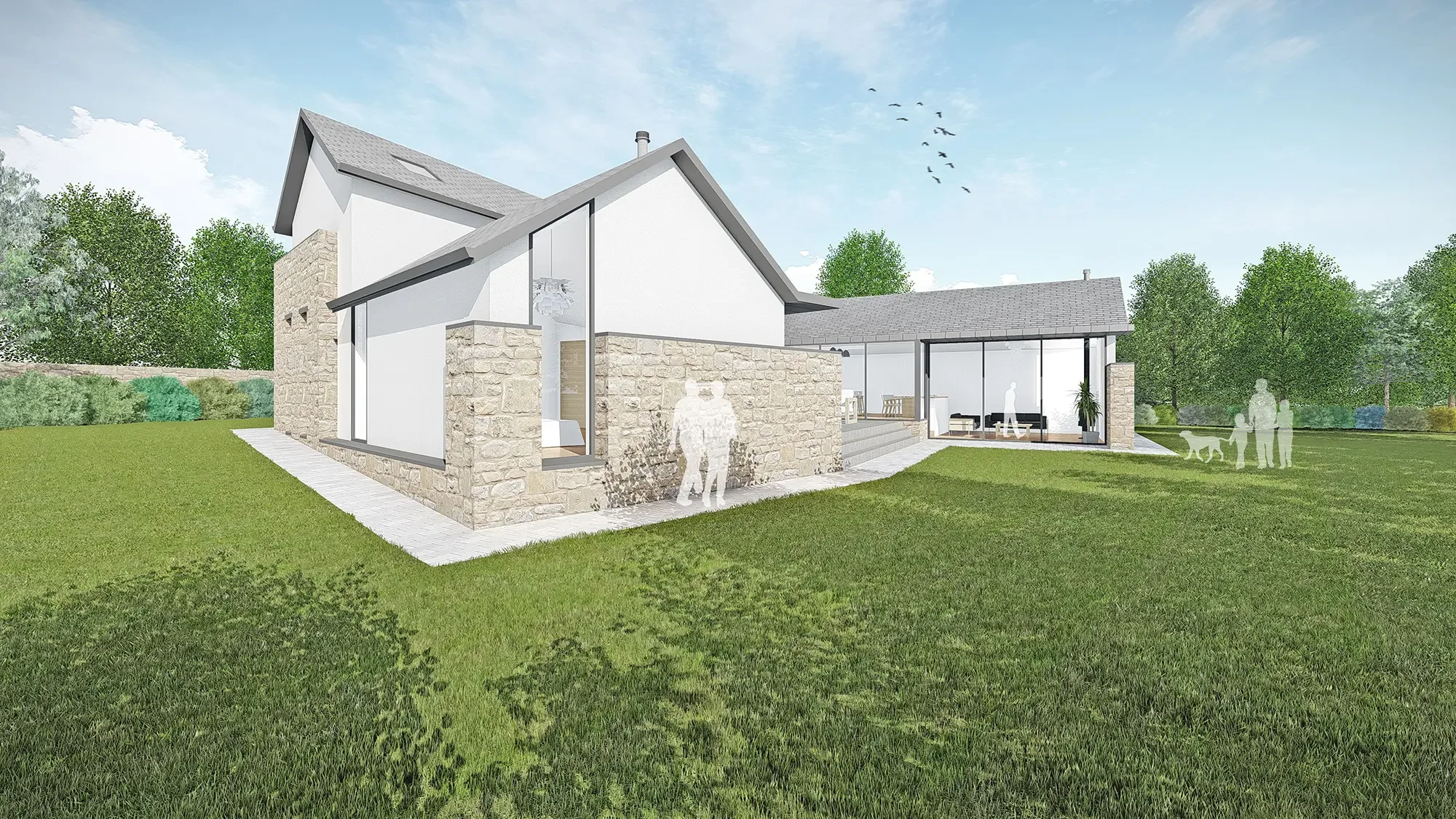
Even where replacement is acceptable in principle, the form of the new house is critical.
In Angus, replacement dwellings are typically assessed on whether the proposal:
Respects the scale and presence of the existing building.
Sits comfortably within its landscape or settlement context.
Avoids unnecessary visual prominence.
Reflects local patterns of development.
Replacement does not usually provide an opportunity for disproportionate enlargement or unrelated design ambition. Proposals that are clearly more dominant than what they replace may attract closer scrutiny.
When replacement may be preferable to new build.
In some situations, replacement can be a more realistic route than proposing a completely new dwelling.
This may apply where:
An existing house already establishes residential use on a site.
New development would otherwise be resisted in open countryside.
Servicing, access and siting are already proven.
The existing building no longer meets modern requirements.
Replacement may become more cost effective than refurbishment where existing buildings have fallen into disrepair and VAT considerations are resolved.
Understanding whether replacement strengthens the planning case — rather than weakens it — is an important part of early feasibility work.
Common assumptions that cause difficulty.
Replacement dwelling proposals often encounter problems where assumptions go untested.
Common issues include:
Assuming any existing building qualifies as a dwelling.
Treating replacement as a “like for like” entitlement.
Underestimating the importance of siting and scale.
Designing before the principle has been properly assessed.
Addressing these issues early can help avoid refusal or costly redesign.
A planning-led approach to replacement.
A planning-led approach allows replacement proposals to be shaped by context and constraint from the outset, rather than forced to fit policy after design decisions have been made.
Early advice typically focuses on:
Confirming whether replacement is acceptable in principle.
Identifying constraints linked to landscape, access or designation.
Advising on appropriate scale, form and positioning.
Clarifying risk before significant costs are incurred.
At this stage, clarity matters more than speed.
Related self-build considerations in Angus.
Replacement dwellings often sit alongside wider questions about land, feasibility and planning strategy.
You may also find it helpful to explore:
→ Can I build on my land in Angus?
→ Planning permission for a house in Angus
Each route carries different implications and levels of risk.
Making informed decisions early.
Every replacement dwelling proposal is different. While policy provides a framework, outcomes depend on careful judgement and an understanding of how decisions are made.
We work with clients across Scotland to assess replacement opportunities honestly and to advise on realistic routes forward — whether that involves progressing a proposal, refining expectations,or reconsidering the approach altogether.
An early conversation can bring clarity before commitments are made. When the time is right for you, we are always available to offer initial impartial guidance.