Building Contracts in Self-Build and Home Extension Projects


Why should I use a Building Contract when procuring construction work?
There are many steps in the process of building or extending your home, from the initial impulse and the conversation that will begin your journey, to the moment when the last of the furniture is in place and the landscaping begins to settle in earnest. Building; or refurbishing and extending your own property entails an unusual and sometimes difficult mix of dealing with businesses and professionals while seeking something which is inherently intimate; the space in which you spend your life, form your relationships and attend to your ambitions.
One of the key areas where these two disparate facets can come into conflict is once the final plans have been drawn, and you are in the process of actualising your build. In short, the issues of finance, daily disruption and construction timescales are in most risk of flux when the ground has been broken and the work has begun.
In order to ensure that this process is as painless as possible, there are a few precautionary steps you can take; choosing from trustworthy contractors, listening to the advice available from the professional team, and finally, choosing a contract which will leave you in a position of balance and security should challenges arise.
Why should I use an independently prepared form of Building Contract?
Using a standard form of building contract will ensure impartiality and independence of terms; and provide a fair split of the project risks between Client and Contractor. Contracts or terms and conditions written or offered by a Contractor will, invariably, be written in favour of the contractor in terms of payment timings, mechanism and the distribution of risk. Contractor’s terms can vary widely in small works and over the course of our careers we have seen some truly outrageous terms offered by domestic contractors. Even legally prepared terms which acknowledge their own unenforceability and illegality within the small print. Be very careful of this and aware of what it means on the ground. In a deviant contractor’s eyes the domestic marketplace can be unregulated a lot of the time and free from the ‘burden’ of professional advisors.
Using a standard form of building contract ensures that the contract is legally binding, enforceable and is independently prepared and appraised to ensure the distribution of risk is fair and appropriate between the contracting parties. Competent contractors have no problems working to the standard forms of agreement. Should a contractor resist, alarm bells should sound and you should think seriously as to whether you wish to commission and trust that company to work on your property.
What is the role of the Architect as Contract Administrator?
The role of the Contract Administrator is, fundamentally, to administer the terms of the building contract. In practice this means the Architect will act impartially between the contracting parties, if they are doing their job properly. Construction work represents significant effort and financial transaction. It is commonplace for there to be challenges during construction works which must be resolved for projects to be successful. Equally human nature dictates that both parties to the contract will seek to skew the outcomes in their favour. Push too hard in either direction and problems are sure to arise.
The role of the Architect is to mitigate and advise impartially. The Contract Administrator ultimately has control of the project finances and the capacity to over-rule either Client or Contractor’s view, provided they operate within the terms of the contract. Architects are trained for a number of years in the use and implementation of Building Contracts and, on small projects will have greater understanding of the terms than either Client or any typical small Contractor. Professional Consultants also carry professional indemnity insurance and are professionally regulated to ensure that their work and actions are carried out in accordance with professional expectations.
It can sometimes be difficult for a Client to understand why their architect is telling them that they must pay a bit more for additional work, or that their Client’s views are not correct. Some small builders are sometimes hesitant or resistant to entering into contract where there is a Contract Administrator involved, recognising they are dealing then not directly with the Client, but with someone trained in the administration of contractual terms and with ultimate control of the project finances.
In reality, it is in both parties interests to have an independent person acting impartially and resolving project challenges as they arise. Builders and Clients alike should recognise that where either party to the contract does not operate within the terms, they can rely on the support of the Contract Administrator to assist them in resolving difficulties.


Why is it in a builder’s interests to use a building contract and contract administrator?
There are lots of reasons why it is equally in a builders interests to use a standard form of building contract. Domestic clients can be notoriously emotional, unreasonable or demand extra work and expect that it does not result in additional costs. The use of a well created set of contract documents and standard form of building contract will set out clearly the works the builder has been asked to price, those which remain the responsibility of the client and those whereby there may be unknowns remaining until such time as opening up works are carried out. This will provide a contractor peace of mind that a naughty Client won’t be asking for extra work whilst expecting not to pay! And in the event that it does happen, the contractor can rely on the support of the contract administrator to resolve the matter.
Similarly if a Client does not pay for works that have been certified, the Contractor can expect that the Architect would provide support to the Contractor to pursue the Client for recovery of the costs through legal means. The role of the Contract Administrator is to act impartially and done well, should provide an appropriate risk distribution to both client and contractor; and security of knowledge that there is an independent voice to finalise challenging decisions and provide support to resolve technical queries.
What contracts are suitable for use on a self-build or home extension projects?
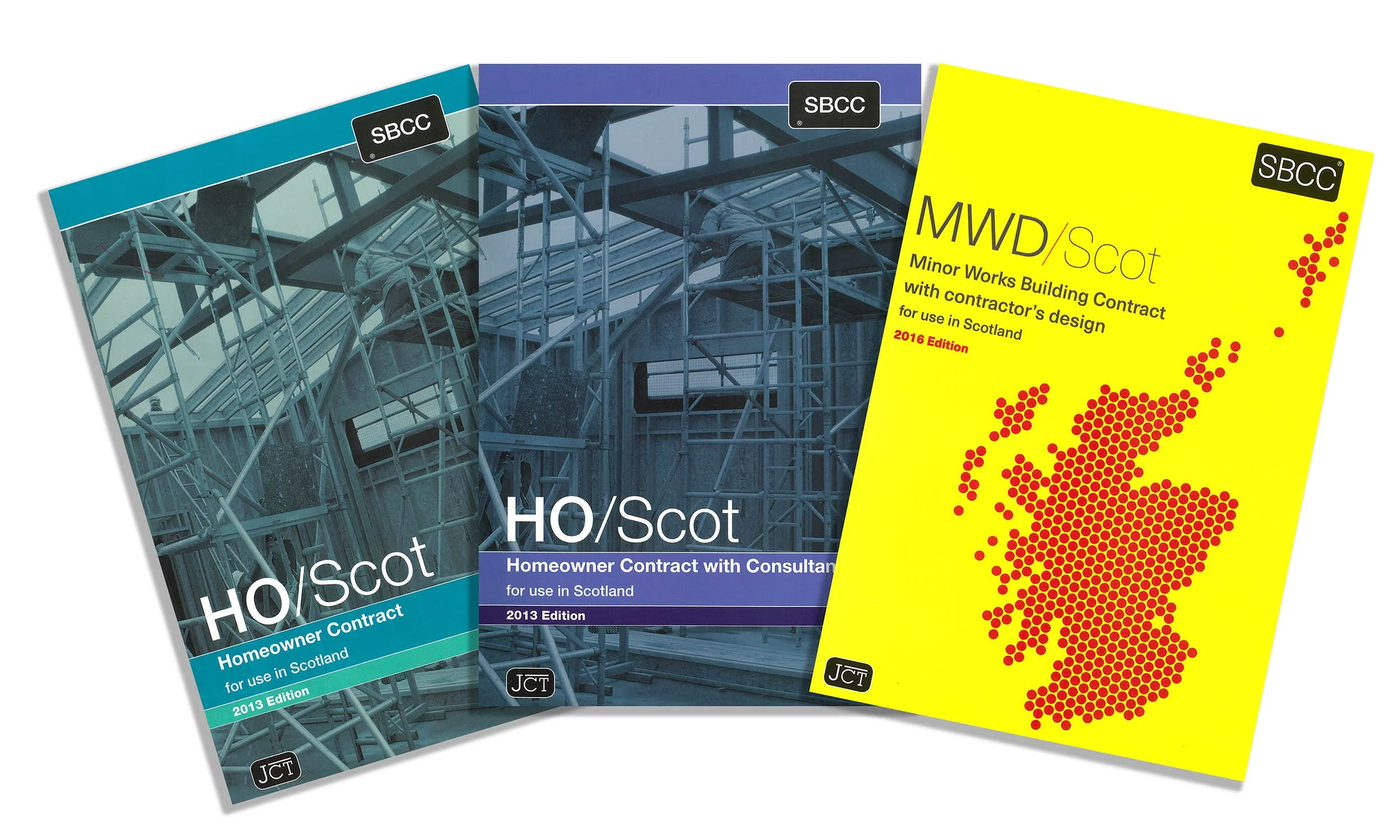
In the following paragraphs we have provided abbreviated background on the different types of building contract available and commonly used in small and domestic construction works. This will focus on the options for payment mechanisms to the contractor and for professional involvement during construction.
What is the JCT / SBCC?
The Joint Contracts Tribunal (JCT) is the UK wide independent body recognised as the industry standard for production and publication of Standard Forms of Building Contract for use in the Construction industry. The JCT was formed in 1931 by the Royal Institute of British Architects and National Federation of Building Trades Employers. The JCT produce contracts for homeowners and small scale works through to larger contracts known as the Standard Building Contract or Design and Build Contract. These contracts are used virtually without exception across the construction industry. This should provide peace of mind to any prospective Client that the terms offered are independently prepared and verified, binding and represent a fair and reasonable distribution of project risks between parties to the contract.
The Scottish Building Contracts Committee (SBCC) is effectively the Scottish arm of the JCT. It provides expertise and adjustment to the JCT publications to ensure that the contract used recognises the differences between Scots and English law and is binding in the Scottish Courts. Again the SBCC is an independent body.
It is important to note the difference between Scots and English law and understand that in Scotland, where contracts display the SBCC logo on their cover or are titled ‘for use in Scotland’ these contracts have been adapted to suit our legal system. All Clients and their professional advisors in Scotland should ensure use of the appropriate contract.
Any single golden rule for small and domestic construction projects?
Yes, simply put, never pay in advance. This simply cannot be emphasised enough. Advance payment will alter the dynamics throughout the project and render you vulnerable in the event of dispute. Skilled and competent contractors recognise this and do not ask. If you are ever asked to pay in advance for construction works alarm bells should sound and you should question if this is the correct company to entrust with your property.
SBCC Minor Works
Monthly Valuations and Payments.
Requires a Contract Administrator to be successfully implemented. Valuation procedure more involved than staged payment solution.
Can leave ambiguities which create potential for difficulties with the contractor or payment dispute if detailed cost breakdowns are not available and works completed are not easily quantifiable. Some contractors will seek to front-load valuations to skew the balance of control during the works in their favour. Be very aware of this approach in small or domestic construction works, it should set alarm bells ringing!
In real terms this contract requires a detailed cost breakdown either from transparent contractors costing, quantity surveyors bill of quantities or Architects schedule of work which has been priced by all tenderers.
Widespread use and Contractors tend to favour this approach over Staged Payments since it allows their preparation of monthly valuations during construction to be submitted for professional review.
Minor Works Contracts were typically in use on domestic projects until 2013, when homeowner contracts were introduced to align better with lenders constraints and in recognition that on some domestic projects a Quantity Surveyor or schedule of works may not have been commissioned and as a result, the ambiguous nature of monthly payments in the absence of a schedule of works became a common source of dispute.
You can find out more about the SBCC Minor Works Contract on the link.
SBCC Homeowner Contract
Pre-Agreed Staged Payments between Client and Contractor with no professional involvement during construction.
Provides legally binding contract which can be monitored without professional involvement during the construction phase.
Suitable for Clients who feel confident in managing the Contractors during construction themselves and do not require ongoing professional support.
Staged Payments are pre-agreed and leave no ambiguity.
Provides incentive for contractors to complete each work stage and reach payment position.
In this contract the construction company reports directly to the Client, the Client must address Contractor’s queries and variations.
You can find our more about the SBCC Homeowner Contract on the link.

Coach House procured using SBCC Minor Works Contract.

Boghall House procured using SBCC Homeowner Contract with Consultant.

Coach House procured using SBCC Minor Works Contract.
SBCC Homeowner with Consultant Contract
Pre-Agreed Staged Payments between Client and Builder with Architect Inspections and Interim Certificates.
Staged Payments are pre-agreed and leave no ambiguity.
Provides legally binding contract with professional support and management during construction.
Provides incentive for contractors to complete each work stage and reach payment position.
Any variations to the contract are controlled by the professional team via instructions.
Client liable only for payment of instructed variations only.
Stages can be difficult to define when projects become more complex, in our experience over around £750k construction cost. In such circumstances it may be more effective to consider use of an alternative form of building contract and ensure that the services of a Quantity Surveyor are procured to develop pricing schedules and provide support in controlling valuations.
In this contract all parties to the construction report to the consultant, who is responsible for administering the contract terms fairly between client and contractor. Professional certificates are required for release of payment to the contractor.
You can find more details about the SBCC Homeowner with Consultant Contract on the link.

Arnothill, Falkirk procured using SBCC Homeowner with Consultant Contract
Staged Payments
The latter two of the above contracts differ from Minor Works through their use of a staged payments system in contrast to a monthly or time based procedure. On a very basic level the increased protection for the client should be obvious; contractors are paid for work completed and when key milestones are achieved, rather than on a monthly basis. Moreover the payment stages will have been pre-agreed and as such the Client is able to accurately anticipate payments due and forecast those forthcoming throughout the construction process. A Minor Works approach leaves greater uncertainty in this respect as the level of payment requested will not become fully clear until the Contractor submits his application for payment.
Variations will be incorporated into the Contract in either situation and via instruction from the acting consultant.
Below is a breakdown of the stages of payment as they are typically organised in these contracts:
Suggested Stages of Payment for a typical Domestic Extension:
Substructure and Drainage up to DPC level
Superstructure (All above ground structure)
Weather Seal
Completion
Retention Release (3 Months Post Completion, 5%)
Suggested Stages of Payment for a typical New Build:
Substructure and Drainage up to DPC level
Superstructure up to first floor level
Superstructure up to wall plate level (up to roof level)
External Envelope Complete (Weather Tight)
First Fix Electrics, plumbing and carpentry complete
Second Fix Electrics, plumbing and carpentry complete
Receipt of completion certificate from Building Control
Retention Release (3 Months Post Completion, 5%)
What requirements do mortgage lenders have?
Mortgage Lenders will always look for staged completion as a prerequisite to the release of funds because of the potential risks of small scale construction. By agreeing staged payments with your contractor you will ensure that you are never paying for work which is as yet incomplete. Homeowner Contracts offer opportunity to align the stages of payment release with the requirements of the lender.
Final thoughts.
We hope we have made the process of securing the correct contract more transparent for anyone thinking of entering the residential building process for themselves, be it for a small or more elaborate extension, or a new dwelling. The currently available contracts provide the scope for a well protected client to navigate the all important construction stage of the process with safeguards and peace of mind.
Small contractors should also take comfort that their Client has gone to the trouble of preparing sufficient information to allow detailed understanding of the works to be priced and implemented a Standard Form of Building Contract, recognising the need to keep both parties to the contract safe during the works.
Related Information | Local Architect Dundee
Self-Build Homes – Guidance and inspiration for designing and building your own home.
Extensions – Explore our advice and case studies on home extensions.
Dundee Conservation Areas – Learn more about Dundee’s Conservation Areas.
Building contracts in self build and home extension projects.